
March 18, 2026 • Xtpcasino.net editorial team
What this page used to say. An earlier version told of “Mark”, who lost $3,800 in forty minutes at the XTP Casino roulette table, hurled his last $100 chip across the felt in rage, saw it land on zero and was paid $3,500 because the casino “ruled it a valid wager”; he then visited the “responsible gambling desk” and came back six months later to win $1,200. XTP is an online casino: there is no felt, no table to throw a chip across and no desk on a casino floor, so those details were invented. The story had no surname, date or record that could be checked (some versions were even signed with another casino’s name), and it has been removed.
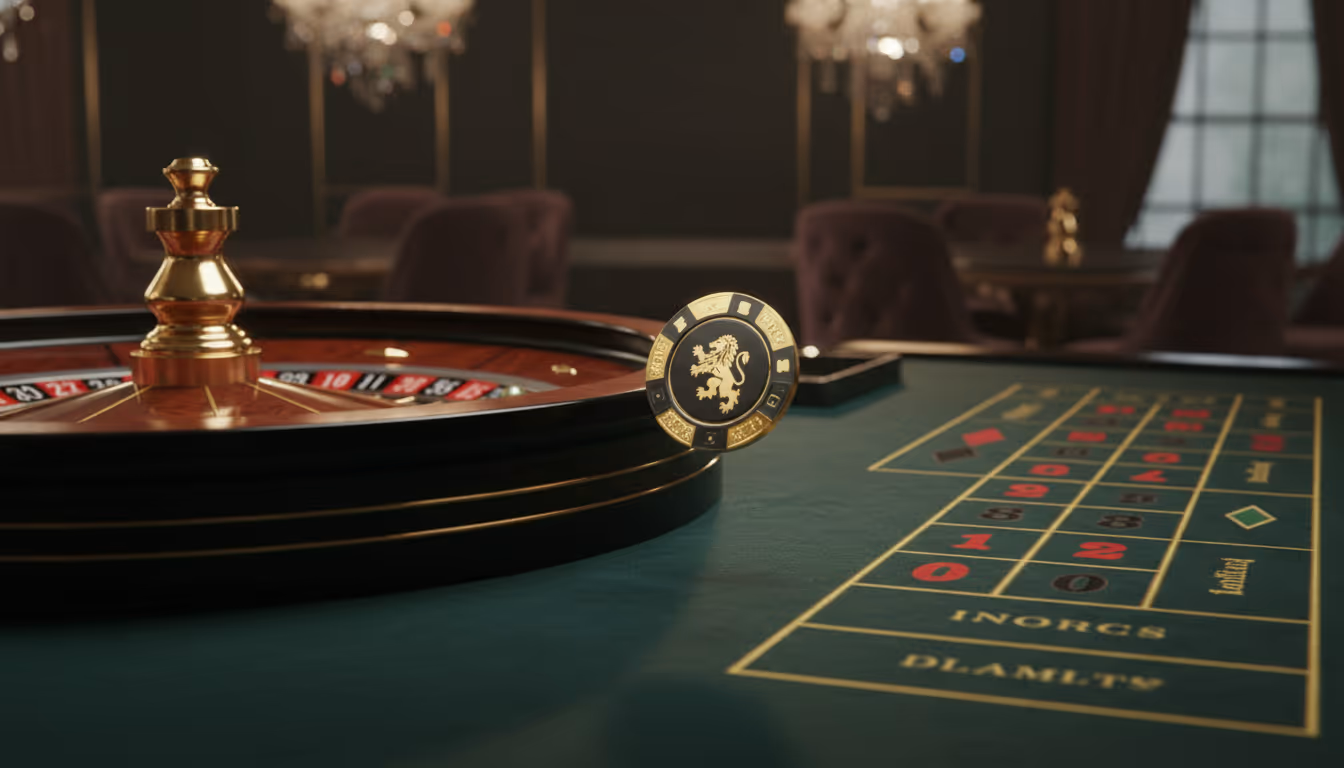
Even the story’s miracle leaves him $300 down
Take the numbers at face value. A straight-up bet on one number wins about once in 37 spins on European roulette and pays 35 to 1, so the $100 chip returns $3,500 in winnings plus the $100 stake. Against the $3,800 already lost, the night still ends $300 in the red. The story presented a partial recovery as a triumph, which is exactly how a lucky hit after a losing run feels at the time.
The odds were not better because he was angry. Every standard bet on a single-zero wheel keeps 2.70% for the house on average; on a double-zero (American) wheel it is 5.26%. That $100 chip had an expected loss of $2.70, however it reached the table.
| Bet (European roulette) | Chance to win | Payout | House edge |
|---|---|---|---|
| Single number | 1 in 37 (2.70%) | 35 to 1 | 2.70% |
| Red or black | 18 in 37 (48.65%) | 1 to 1 | 2.70% |
| Dozen | 12 in 37 (32.43%) | 2 to 1 | 2.70% |
| Any bet on an American wheel | lower (38 pockets) | same payouts | 5.26% |
What losing $3,800 in forty minutes tells you
At a steady pace and a steady stake, roulette loses money slowly. A live-dealer wheel spins roughly 40 times in forty minutes; at $20 a spin that is $800 wagered and an expected loss of about $22. To lose $3,800 that fast, you either bet very large amounts or keep raising the stake after every loss. That second pattern has a name: tilt. Anger makes bets bigger, faster and less planned, and doubling up to “win it back” only increases the amount exposed to the same 2.70% edge.
The most dangerous part of the old story is the ending it chose. A win right after a rage bet teaches the brain that anger works. It does not: had the chip landed anywhere else, which happens 36 times out of 37, the night would simply have ended $3,900 down.
How to stop before anger decides
- Set a loss limit before the first spin and treat it as the end of the session, not as a target to recover.
- Use a fixed stake. If you notice you are raising it after losses, stop.
- Take the pause the old story only pretended to take: close the game for at least 15 minutes when you feel angry. Online, the next spin is always one click away, which is why the break has to be deliberate.
- Know what you are playing with. XTP describes itself as a crypto casino; a crypto balance can also move with the coin’s price, so set your limits in the currency you actually think in.
A practical takeaway. Set deposit, loss and time limits in your account before you play, stop at the limit rather than chase, and never gamble on credit. Check that you are allowed to play at all: XTP’s own list of accepted countries includes Finland but not France, Poland or Greece. If anger or chasing keeps coming back, contact your national gambling support service.
Exhaustion, the next stage of a long session, is examined in what 19 hours of slot play actually costs, and gambling that crowds out family life in when a casino night replaces an apology.
Frequently Asked Questions
Can you win at roulette by betting on zero?
Zero has exactly the same chance as any other number: 1 in 37 on a European wheel, paying 35 to 1. No number or bet type avoids the 2.70% house edge.
Is a chip thrown onto the table a valid bet?
At a land-based table the dealer decides, and a chip that lands after bets are closed is normally not accepted. Online the question does not arise: bets are placed by click and locked before the spin.
What is tilt?
Tilt is playing under strong emotion, usually after losses: bigger stakes, faster bets and no plan. The simplest defence is a loss limit set in advance and a mandatory break when you feel angry.
Anger does not change where the ball lands; it only changes how much is on the table when it does.